
Tanker behavior
Strategy comes from above — and dissipates in the day-to-day.
Board has a strategy paper. Divisions build their own plans around it. Operating teams hear about purpose only at the all-hands. Daily work follows its own logic.
 The Octopus Principle®
An octopus organization starts with clarity. Who are we? Why do we exist? Where do we want to go? Whom do we serve?
Positioning is not rigid planning — it's shared orientation.
Like navigating at sea, you need an honest assessment of where you are, a clear picture of where you want to go, and a shared route. In complex environments this clarity creates stability. It allows autonomous teams — the arms of the octopus — to act on their own without losing the shared direction.
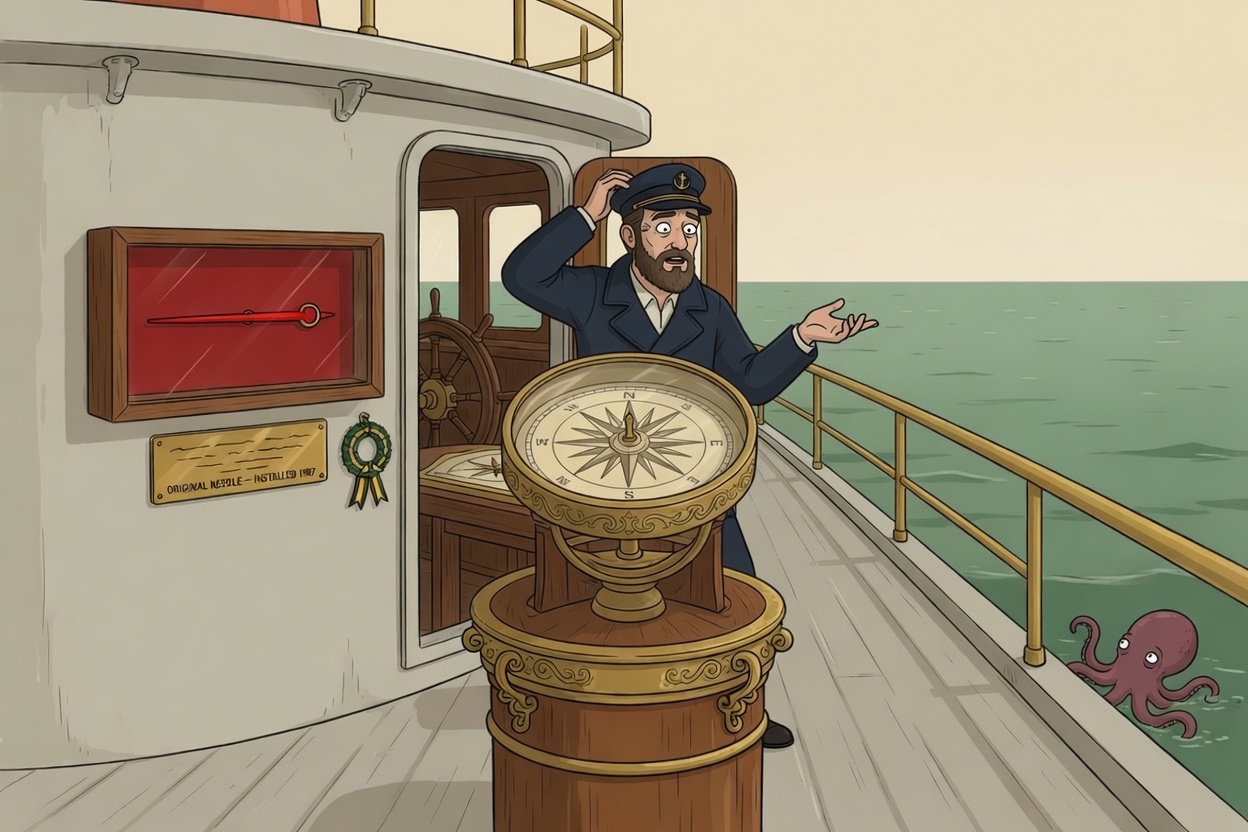
Eine Beispiel-Blockade aus dem POWER-Prinzip Positionierung.
Purpose, mission, values as a shared reference — not as decoration, but as a compass for everyday decisions.
Where are we really — as a market, as an organization, as a team? Not embellished, not shamed. Clear.
What are we building together? Concrete enough that everyone rows in the same direction. Open enough that each finds their contribution.
Clear strategic milestones — and enough room for teams to make local routing decisions on the ground.
Board has a strategy paper. Divisions build their own plans around it. Operating teams hear about purpose only at the all-hands. Daily work follows its own logic.
Board and teams have the same target in mind. Operating decisions are checked against the north star. When a team sees a route correction, it can act without asking the board.
Identity and meaning, paired with strategic clarity, align all forces toward the same goal.
Take the test→