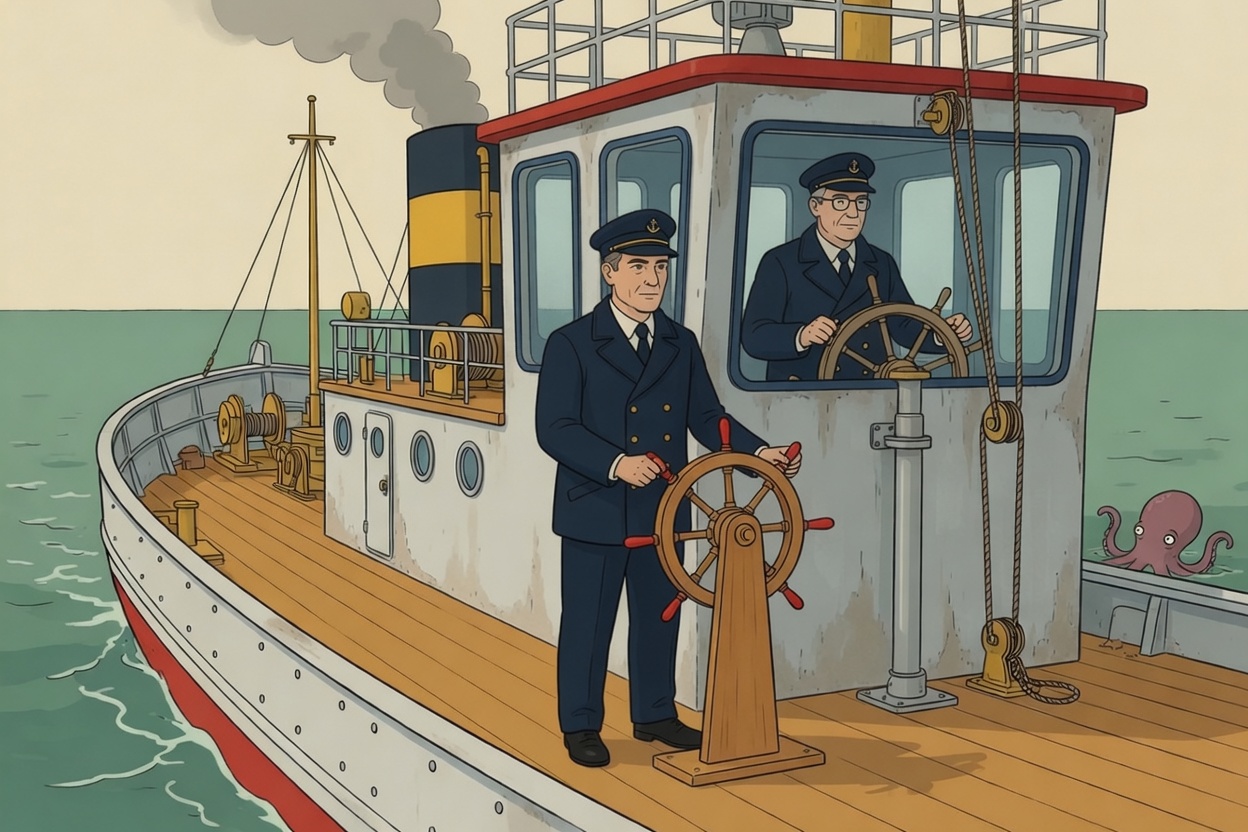

Tanker behavior
Everyone waits for the decision.
There's a problem. No one acts because no one is sure they may. Escalation upward. The board decides — usually with too little info, sometimes too late. Responsibility is everywhere and nowhere.
 The Octopus Principle®
In an octopus organization everyone takes ownership — not just for tasks, but for outcomes and development.
Mandate, not command. Responsibility is not handed off — it's consciously taken on.
Autonomous arms only work if they carry responsibility. Ownership strengthens self-efficacy and engagement. It creates a culture in which people don't wait for instructions but act with accountability. Ownership explicitly includes a willingness to learn and to solve problems creatively. Mistakes aren't delegated — they're reflected on.
Not just responsible for the task, but responsible for the result. Initiative on problems — without being asked.
Decide when the information is there — don't wait until someone else has decided. Stay capable of action even under uncertainty.
Ownership needs cover. A clear mandate of what may be decided in your area, and protection when a calculated risk doesn't pay off.
When something doesn't work, the first question is: What do I learn from this? — not: Whose fault was it? Willingness to learn is part of responsibility.
There's a problem. No one acts because no one is sure they may. Escalation upward. The board decides — usually with too little info, sometimes too late. Responsibility is everywhere and nowhere.
There's a problem. Whoever sees it has the mandate to act — within clear boundaries. When unsure, they consult — not delegate. The organization learns about problems through solutions, not through escalation.
